
A Tiny Fish Could Transform How We Treat Cancer In Kids
UK RESEARCHERS TURN TO ZEBRAFISH
FOR REAL-TIME DATA ON TUMORS
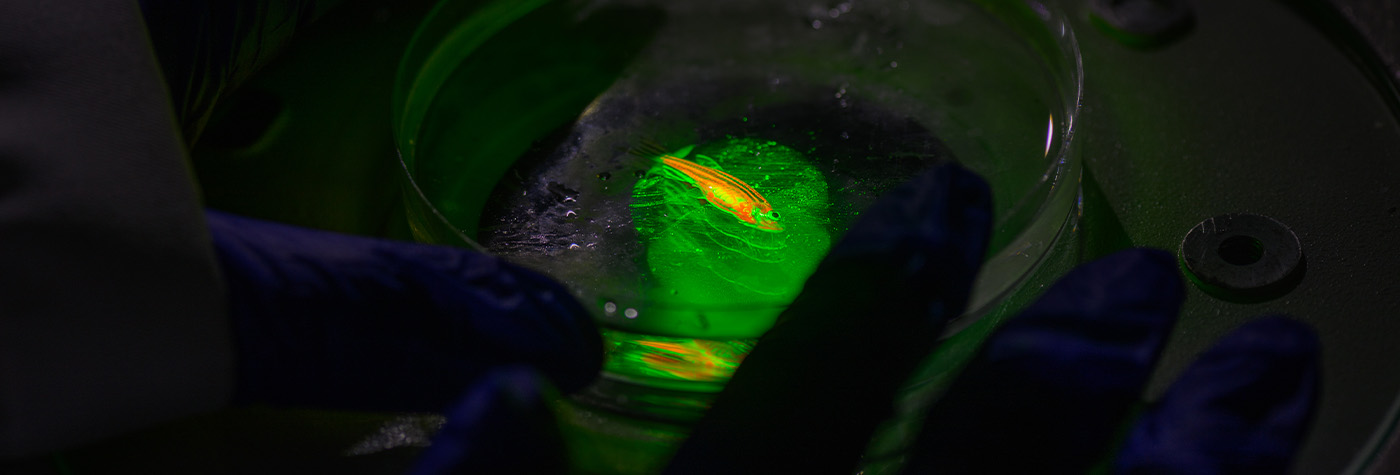
A tiny fish with translucent skin could make a big difference in how we treat patients with pediatric cancer — and the research is happening right here at the UK Markey Cancer Center.
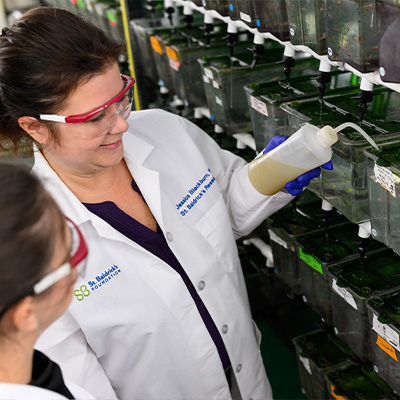
Zebrafish are tropical freshwater fish native to South Asia, and they are particularly useful for cancer research, said Jessica Blackburn, PhD, Markey researcher and associate professor of molecular and cellular biochemistry. The fish can offer important insights into cancer biology, which in turn can power the discovery of less toxic and more effective treatments.
Why Zebrafish?
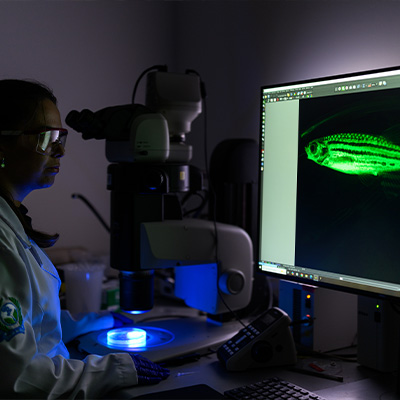
Because the skin of zebrafish larvae is clear, Blackburn and researchers in her lab can watch tumors develop, from one cell to a whole tumor, through a microscope. That level of real-time detail isn’t possible with other research models. Zebrafish also metabolize drugs in a way that closely mimics how people process drugs; therefore, the fish can provide better insights into how drugs might work in patients compared to typical cell culture methods.
Zebrafish also share 70% of their genes with humans. Certain genes are overexpressed in cancers, meaning they make too many copies of a protein or another substance. Blackburn said her lab can often find those exact human genes in zebrafish. Researchers can then give the fish tumors, manipulate the genes, and see how the tumors grow or respond to different drugs.
Relatively few labs use zebrafish for cancer research, but there are a growing number worldwide. Blackburn, a proud Kentucky native and first-generation college graduate, initially worked with zebrafish during her post-doctoral cancer biology fellowship at Harvard University.
The Avatar Model
Cancer treatments have come a long way in recent years. Many tumors are sequenced to learn which specific genes have changed. However, that sequencing doesn’t always provide doctors with all the necessary details to determine which drugs would be most effective for each child.
tumor growth in zebrafish.
That’s where the Avatar model comes into play. First, researchers take a sample of a child’s tumor cells and inject those cells into the zebrafish. They then treat the fish with various drugs to find out which ones work best for that individual child.
“We have a functional test where we can put each drug into the fish and see how the tumor responds or doesn’t respond to those drugs. If we can get that to work, that might help clinicians figure out the best treatments for these kids,” Blackburn said.
Using zebrafish allows Blackburn to get data incredibly quickly. There’s a five-day wait from when she receives the patient sample to when the data is ready — meaning providers can make fast decisions regarding treatment. Similar models with mice take up to six months. “Sometimes kids don’t have six months, so this could be a complement to what clinicians are already doing,” she said.
Making a Difference for Children With Cancer
Blackburn is applying for a grant to gather more data and conduct additional testing, with the hope that this process will be beneficial for patients in the near future.
“First, we need retrospective data. This involves looking at patients who have already been treated. We’ll use their banked samples to perform testing on the zebrafish and see if our results match what the clinicians observed,” she said. The next step after that is to gather data on how the fish-tested treatments work in patients.
While there are treatment options for many childhood cancers, a lot of those treatments have serious, long-term side effects. Blackburn wants to improve those treatment options and translate leading-edge scientific discoveries into meaningful therapies. “I feel like there’s a lot of room for improvement, and fish models can help us find better drugs,” she said.
Supporting Student Researchers
Blackburn is a passionate mentor, deeply committed to fostering an inclusive and supportive training environment that empowers tomorrow’s scientists. More than 50 undergraduates who have trained in her lab have gone on to earn medical degrees. “We’ve done a lot of training of the next generation of scientists and doctors,” said Blackburn, who recently won the Early Career Mentoring Award from the UK College of Medicine.
That next generation includes Majd Al-Hamaly, PhD, who recently finished her time as a pharmacology doctoral student in Blackburn’s lab. Al-Hamaly’s research focused on finding the mechanisms responsible for recurring T-cell acute lymphoblastic leukemia. She used zebrafish to screen over 770 FDA-approved drugs to find compounds that stop leukemia cells from growing and multiplying. She also identified a protein that was not previously known to control the ability of this type of leukemia to self-renew. This discovery opens up new ways to develop drugs that specifically target and stop leukemia.
Using zebrafish makes it easier to screen hundreds of drugs quickly, Al-Hamaly said. “Zebrafish really help you narrow down that list in a very translational, biologically relevant way compared to what you can do with cell cultures,” she said.
Al-Hamaly appreciated the mentorship and training she received during her time in Blackburn’s lab, which included a weekly data club, career planning lunches, and training in scientific communications and presentations.
“[Blackburn] dedicates so much of her time to properly mentor her trainees and make sure they receive the best scientific and personal experience possible in her lab,” Al-Hamaly said. “She really helps you navigate your PhD journey and provides you with the resources to get what you want out of your training.”