
Empowering New Researchers
BOOTCAMP ENSURES SUPPORT FROM
CONCEPT TO CLINICAL TRIAL
An innovative program at the UK Markey Cancer Center trains and supports the next generation of cancer researchers as they seek to improve patient outcomes and move us closer to a cure.
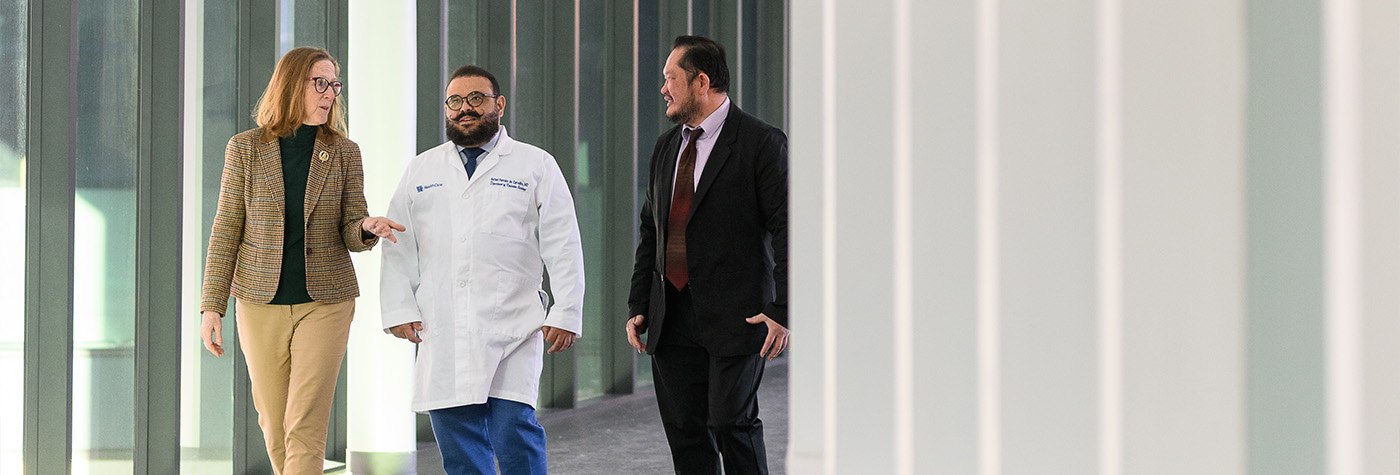
The Clinical Trials Bootcamp program helps junior faculty grow their ideas from a concept to a research study. Susanne Arnold, MD, the Markey Cancer Center’s first associate director for Clinical Translation, started the bootcamp in 2013. She saw the challenges junior faculty face in creating new clinical studies and wanted to give them the tools and support they need to succeed.
“New faculty have great ideas and enthusiasm, but they lack experience in creating effective clinical trials,” Arnold said. “We want to help bridge that gap with support from senior clinician scientists.”
Intensive Research Training
The bootcamp is an intensive training program that gives new researchers an overview of the clinical trials development process as well as best practices for designing and conducting cancer clinical trials. Participants develop a novel scientific concept into a new clinical trial and collaborate with senior faculty mentors who offer insights and advice.
“Watching research ideas grow from a concept to a study available for cancer patients is rewarding for early-career researchers,” said John L. Villano, MD, PhD, the bootcamp program and the Assistant Director for Clinical Education and Mentoring.
Participants also learn about Markey’s professionally staffed Shared Resources, which provide access to the services, instruments and technologies investigators need to conduct research. This includes statistics and DNA sequencing.
At the end of the bootcamp, project leaders can choose to apply to internal funding opportunities, or apply for grants from the National Cancer Institute, industry partnerships and other sources.
A Startup Incubator
The clinical trials bootcamp is a lot like a startup business incubator, said radiation oncologist Rafael Ferreira de Carvalho, MD, whose proposal went on to secure funding. “You get the resources, training and guidance you need to take your plan from concept to reality, along with the funding and ongoing support,” he said.
Carvalho built a successful medical and research career in his native Brazil, but he decided to move to the United States in 2021. He completed an additional radiation oncology residency training at Markey and transitioned to a faculty instructor position in 2024.
Although Carvalho conducted research in his home country, the level of support was nowhere near what he gets in Lexington. “Clinical cancer care in Brazil is quite good and I had outstanding mentors, but to test a hypothesis in a low-income country, you often have to pay for your own research,” he said.
Carvalho believed he could make a bigger impact on cancer at Markey. “Treating cancer patients is more than a medical specialty for me,” he said. “It’s the purpose of my life, and I love what I do. But there are other ways to help the community, and maybe the whole world, with new discoveries and new technologies. With new ways to treat those patients, we can improve comfort, improve survival and improve cure rates.”
Looking for a Cure for Head and Neck Cancers
Carvalho is now developing the recruitment phase of what he says will be one of the largest clinical trials in the country. His research project will investigate whether a radiation technique, called spatially fractionated radiotherapy or GRID therapy, could improve cure rates for people with locally advanced head and neck tumors and large metastatic lymph nodes.
These patients are usually treated with chemotherapy and radiation, but the outcomes aren’t great. Carvalho wants to see if a different radiation technique will increase cure rates. “This kind of technique has the potential to prime the immune system and activate cells to kill the tumor,” he said.
Carvalho appreciated the support of his mentors, Arnold and Eddy Yang, MD, PhD, chair of the Department of Radiation Medicine. Yang shared his expertise in basic translational research. “He showed me the ways to perform a deep analysis of the DNA of the tumor in order to better understand the possible genetic changes that GRID treatment can cause,” Carvalho said.
The development process for a research project is long and challenging. Carvalho is currently writing the protocol for his clinical trial. He’s being helped by the Investigator Initiated Trials Office, a Markey-supported team that assists with trial development, and the Markey Clinical Research Office, which facilitates all other aspects of the project. He feels confident knowing he has the support and encouragement to keep moving forward.
Villano believes the bootcamp will help Markey evaluate potential cancer treatments and find new ways of incorporating existing treatments. “Forward-thinking programs like the bootcamp are definitely needed to push the boundaries and provide leading-edge options for our patients,” he said.