
Discovering New Ways to Share Science
AN INNOVATIVE COMPETITION CHALLENGES RESEARCHERS
TO COMMUNICATE CANCER BREAKTHROUGHS
The ability to communicate research findings is almost as important as the research itself.
When scientists use clear, accessible language, they can inform the public about their research in ways that spur even more discoveries and can be translated into real-world applications and societal benefits.
A recent competition at the UK Markey Cancer Center challenged PhD-level graduate students and postdoctoral fellows to present their research to a general audience and share how it benefits Kentuckians.
4 Minutes for Cancer Research
Markey’s Oncology Mentoring, Education, Networking and Training UMbrella (MOMENTUM) Program launched the 4 Minutes for Cancer Research Competition in 2025. The MOMENTUM Program provides education and training for Kentucky’s next generation of cancer researchers. Markey’s Community Outreach and Engagement program also supported the competition by promoting resources that allow researchers to better understand Kentucky’s cancer burden.
The competitors’ objective was this: Give a research presentation in just four minutes – using only one graphic slide – that explains your work and its impact on the people of the Bluegrass State. Participants refined their ideas through several workshops with feedback from their peers and patient advocates. They then competed in two rounds judged by the patient advocates and faculty.
The patient advocates brought a fresh and important perspective to the young researchers. Advocates asked the researchers questions and encouraged them to clarify information and to think more deeply about how they presented their data.
And the Winner Is…
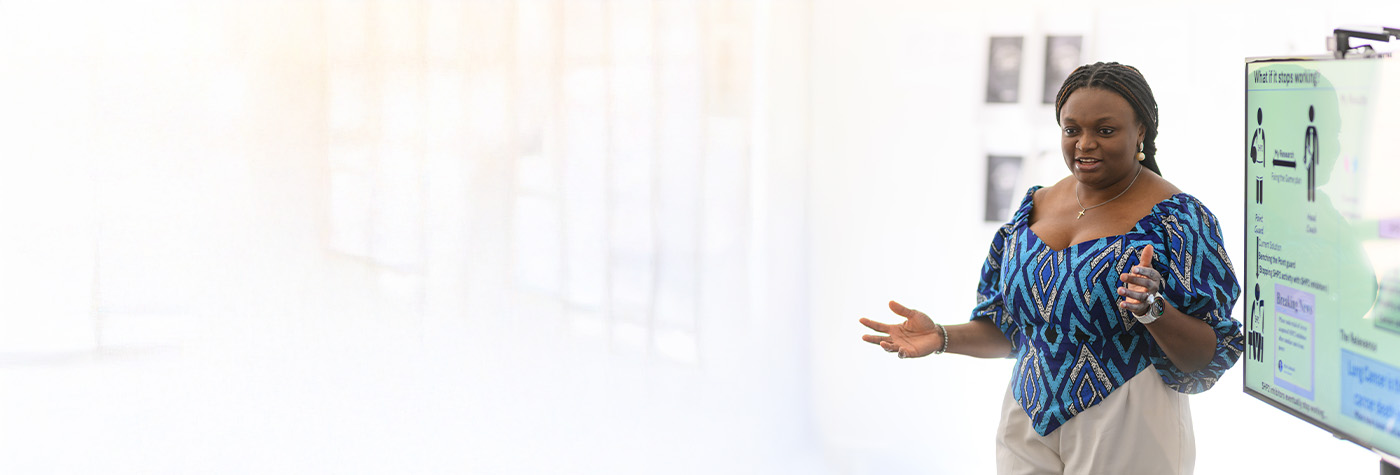
Jovita Daraezinwa, a doctoral candidate in chemistry, won the competition. Her mentors for the project were Kathleen O’Connor, PhD, Markey associate director for Cancer Education and Mentoring, and Samuel Awuah, PhD, associate professor in the Department of Chemistry.
Daraezinwa’s research focuses on identifying and testing potential new drugs for lung cancer. She said scientists aren’t always great at explaining things to laypeople, but she has honed her communication skills throughout her life and participated in debate competitions and other oratory activities.
“I’ve always enjoyed science communication and explaining science to a non-expert audience with everyday language,” she said. Teaching undergraduate chemistry in ways students enjoy also helps her improve her communication skills. “For undergrads to appreciate chemistry, you need to bring it home using their language,” she said.
Daraezinwa gave her winning presentation at Markey Research Day in May 2025. She began by sharing the story of a childhood friend from Eastern Nigeria who died from cancer. She then talked about her lung cancer research by using basketball analogies tailored toward her Kentucky audience.
“If we can present to people in a way where it is interesting and entertaining, but at the same time they are enlightened about a topic, they can appreciate what we do,” Daraezinwa said. “I think of it like having to explain research to my mom or to my grandma.”
Excerpt from Jovita Daraezinwa’s Presentation
My work centers around SHP2, a regulatory protein that becomes dysfunctional in cancer.
Picture SHP2 as the point guard in a basketball game – controlling the flow, making passes and shots, and defending us against disease. But in cancer, SHP2 loses control of the game and cancer wins.
Right now, the main strategy is to bench the point guard – block SHP2 entirely with inhibitors. Many big pharmaceutical companies like Pfizer have invested millions into this approach.
At first, these SHP2 inhibitors show promise. But in clinical trials, they eventually fail because blocking SHP2 completely allows cancer to find other ways to grow.
In my research, I take a different approach: I don’t bench SHP2 – I coach it back into play. I do this by studying the unique relationship between SHP2 and its “head coach,” a protein called UNC5B.
Science Communication Matters
Even though Daraezinwa won the competition, all participants benefited from it. Being able to communicate the goals of research and the importance of the work makes a big difference, whether scientists are speaking to funders, journalists or the public.
“The National Institutes of Health awards research grants based on the potential impact the research could have in the field, and communicating that impact requires skills that take some time to develop,” said Jerod Stapleton, PhD, assistant director for Population Science Education and Mentoring. “Additionally, a core part of our educational and training mission at Markey is to ensure that the center’s research is addressing the most pressing needs in Kentucky. The 4 Minutes competition was designed to hammer home the importance of community impact of research among our trainees.”
Daraezinwa believes helping people understand research can be inspirational. “It gives people hope to think that you’re doing something toward a cure,” she said. “They become willing to hear potential solutions, and they can be champions for that.”
There are also practical implications when people feel they can trust science and researchers. “If researchers can talk about their science in such a way that the lay public can understand it, the public is more likely to believe it,” said Terry Keys, Markey’s research advocacy manager.
“If the public believes the science, they’ll trust it; and, if they trust it, they’ll do what they need to do to take care of both their health and that of their families,” he said. “They’ll get their mammograms. They’ll have the colonoscopies. They’ll have their children vaccinated for HPV and other life-altering diseases.”
Some of the 4 Minutes program participants were good communicators when they began. Others grew more comfortable after the workshops.
Amos Olalekan Akinyemi is a PhD candidate in the Department of Toxicology and Cancer Biology. He created a presentation based on his research into new medications to prevent prostate cancer. “My mom is a teacher in Nigeria,” he said. “I love teaching, and this was an opportunity for me to explain to the world what I’ve been doing behind the bench.”
He appreciated the feedback he received from the patient advocates and took it to heart. “Seeing the people who survive served as a zeal for me to keep doing what I’m doing,” he said.
Akinyemi has won several presentation awards since participating in the 4 Minutes program.
Stapleton said that he felt so optimistic about the state of the cancer research field after watching the competition. “Markey has so many talented young people working on these issues,” he said. “They are enthusiastic, smart people who want to dedicate their time and energy to try to solve these issues that are extremely relevant for folks living in Kentucky.”