
The Kentucky Blueprint

The UK Markey Cancer Center Affiliate Network stands as a premier model of innovation for rural cancer care. And it’s a model that resonates across state lines. When the University of Iowa set out to establish its own statewide network of rural cancer hospitals, they saw Markey not just as a resource, but as the essential blueprint for success.
The Markey Model
The Markey network began in 2006 with a commitment to expanding cancer care, research and education throughout Kentucky. What developed was a scalable system of excellence that had never been seen in rural oncology care. Today, with 20 affiliate sites that span the Commonwealth, Markey is the gold standard for cancer hospital networks.
The network’s success stems from its mission, said Timothy Mullett, MD, MBA, FACS, the affiliate network medical director. “We asked the hospitals, ‘What can we do to make your cancer program better, so that we can make cancer care better in our state?’” In Kentucky, many community hospitals see fewer than 100 new cancer patients a year. The network supports affiliates in achieving Commission on Cancer (CoC) accreditation, which is a requirement for network membership. CoC quality standards are scalable and can be met by both small and large facilities.
 Accreditation is a sign of a hospital’s commitment to high-quality care. The affiliate network is a collaboration, not a competition, Mullett said. Affiliate network hospitals can send their patients to Markey when they need advanced care, with the knowledge that those patients will return to them. “What facilities need is not a competitor,” Mullett said. “They need somebody to help them grow the quality of their program and a resource with the capacity to handle those complex cases.”
The network balances training with direct support for its member hospitals. “Part of what we do is work with the larger cancer centers on educational and clinical programs,” said Cheri Tolle, MAEd, CHES, the affiliate network administrative director. “But we also provide hands-on care to smaller hospitals to enhance treatment for their patients.”
Implementing Markey’s Proven Innovations in Iowa
Recognizing that Markey had cracked the code on rural health networks, the University of Iowa sought to replicate that success. They knew they wanted to create a network. They also knew that their network wouldn’t be based on referrals. Unlike Lexington, the University of Iowa isn’t centrally located. It’s on the eastern side of the state, making it unlikely patients will leave their community hospitals for care. Like Kentucky, though, Iowa has high cancer rates.
“Our rural patients have worse outcomes,” said Ingrid Lizarraga, MBBS, FACS, clinical professor of surgical oncology and endocrine surgery. “As an NCIdesignated cancer center, we have a responsibility to all the patients in our state, not just the ones that come to us.”
The University of Iowa received a grant from the National Cancer Institute to create the Iowa Cancer Affiliate Network (I-CAN). I-CAN supports community cancer centers in providing and expanding services and achieving CoC accreditation.
To support their grant application, Iowa personnel studied the Markey infrastructure. Tolle and Mullett then collaborated with Iowa personnel on research demonstrating that the Markey affiliate network enhances the quality of cancer care in rural community hospitals.
A Visit to the Bluegrass State
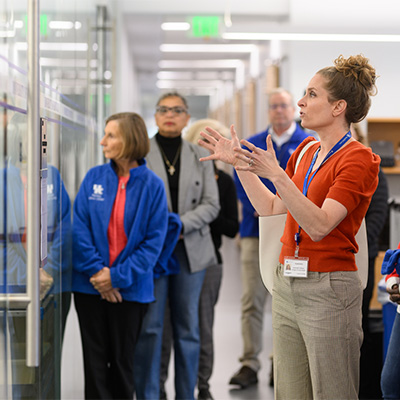
Before they created I-CAN, Lizarraga and others from Iowa visited Markey and many of its affiliate network hospitals throughout Kentucky, including Georgetown Community Hospital, Lake Cumberland Regional Hospital and AdventHealth Manchester.
“Our first aim was to really study the Markey Cancer Center Affiliate Network and learn what the secret sauce was that made it work and made it effective in helping hospitals obtain CoC accreditation,” said Mary Charlton, PhD, I-CAN principal investigator and a professor in the Department of Epidemiology at the University of Iowa College of Public Health.
The secret sauce, it turns out, is relationships.
“It’s about building trust in the network and having the member hospitals’ best interests at heart,” Lizarraga said. “Something that they gave us great advice on from the beginning was how to approach this in a really supportive manner, not a prescriptive or directive manner.”
 The Markey affiliate hospitals are clearly proud to be part of the network, Charlton said. “These hospitals have a fraction of the resources of an academic medical center, but they’re very passionate. They know their communities well, and it looked like MCCAN helped them demonstrate the quality of care that they deliver. It really made us feel like this is the right thing to do, and it gave us a lot of inspiration.”
Reputation is also an important factor, according to Lizarraga. “The reputation of the University of Kentucky and Markey was really important to these hospitals,” she said. “Being able to put that name on their door meant a lot because they felt like their patients really respected Markey.”
Other ingredients in the Markey affiliate network sauce included enhanced access to specialized services and clinical trials, support during the CoC implementation process, networking and community-building opportunities, and support for a culture of data-driven quality and process improvement.
“That was appealing to Iowa,” Tolle said. “We offer educational programming, training, content, shadowing, and quality improvement initiatives to physicians, nurses, social workers, registered dietitians, pharmacists and more.”
Exporting Excellence
While I-CAN continues to grow in Iowa, the foundation of its success remains the Markey model. A few years into their grant, I-CAN now has five partner hospitals. All of the partner hospitals are working toward CoC accreditation.
By exporting the innovation developed in the Bluegrass, Markey is doing more than just supporting another state — it has set a national standard for how cancer care is delivered in rural areas of the nation.
“I feel like we’re making a meaningful difference,” Lizarraga said. “We adapted Markey’s interventions for Iowa and have grown our network and helped our hospitals similarly. Every step of the way, members of the Markey team have supported us.”