Lessons from the Lockdown
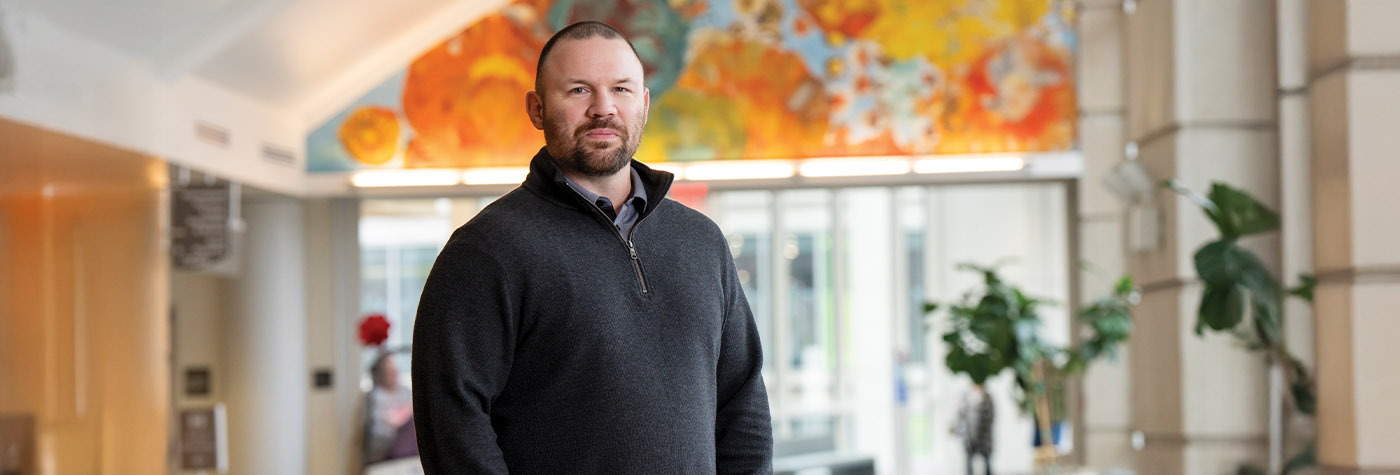
Above: Todd Burus, a data specialist at the University of Kentucky Markey Cancer Center, studied the impact of COVID-19 on cancer diagnosis and treatment.
THE IMPACT OF COVID-19 ON CANCER CARE
When his father died from prostate cancer at the height of the COVID-19 pandemic in 2020, Ben Angel, M.D., confronted a profound realization about the crisis unfolding around him.
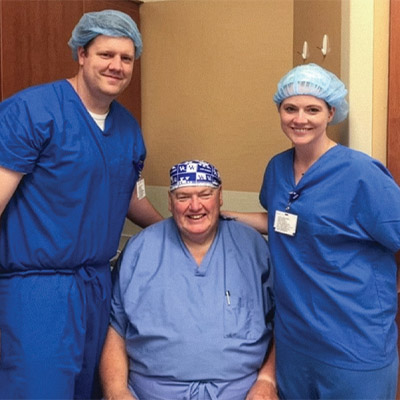
Like so many others during that first year, the urologist at Taylor Regional Hospital in Campbellsville, KY, experienced the pandemic’s toll firsthand — the fear of illness, the strain on healthcare systems, the isolation that defined the era. But his dual role as both a grieving son and a healthcare provider offered him a unique vantage point. He could see how families were struggling with needs that extended far beyond the medical ones.
In his own family’s case, uncertainty loomed over the most basic questions. Would they be able to hold a funeral for their father, who had been a respected physician in the small community?
Could they gather to mourn together? The pandemic, responsible for taking so many lives, also stripped away the support systems that help the living process their grief.
“It was one thing as a surgeon to cancel all elective surgeries,” Dr. Angel reflected. “That had a huge impact on me. But on a personal level, planning my father’s service reminded me that there were many patients, their families and their children who never got that kind of closure we were able to have. To me, that realization was staggering.”
Burden on the System
Five years after the COVID-19 pandemic upended the world, the experience remains raw for many healthcare providers. You can hear it in their voices when they pause mid-sentence as they recall the surge of patients. Their tone shifts as they describe making impossible decisions with limited resources — choices made even more wrenching when colleagues fell ill and relatives and friends became patients themselves.
“We had to get very creative in our care for patients,” said Shannan Allison, BSN, RN, executive director of nursing at Harrison Memorial Hospital in Cynthiana, which treated the first COVID-19 case in Kentucky. “We opened a cough clinic within three days of the shutdown because our doctors’ offices and ER were getting overrun. And for the most vulnerable, like our patients with cancer, we had to pivot, finding makeshift places in the hospital to provide infusions and sometimes sending nurses outside to administer treatments or deliver medications to reduce the patients’ exposure to possible infection.”
The Hidden Toll on Cancer Care
In Kentucky, where rural communities disproportionately face barriers to healthcare access, the pandemic exposed critical vulnerabilities in cancer care delivery. Patients already traveling hours for chemotherapy appointments found themselves navigating additional obstacles. Some patients experienced treatment delays due to closed centers and reduced hours or their own decision to cancel appointments out of fear of infection. Many also postponed muchneeded screenings.
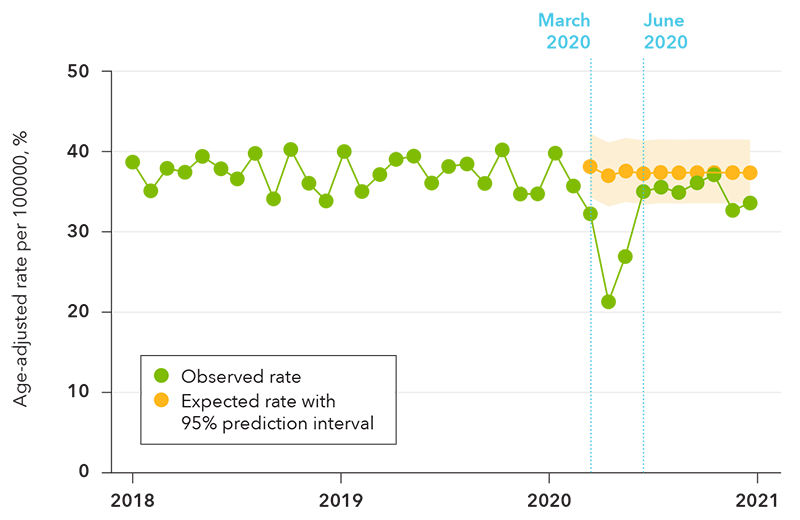
In 2024, JAMA Oncology published a study by Markey Cancer Center researchers showing 9.4% fewer cancer diagnoses than expected in the US during the first 10 months of the COVID-19 pandemic. Kentucky’s data showed a similar result. According to Todd Burus, PhD, assistant professor in the College of Medicine and member of Markey’s Community Impact Office, these numbers didn’t reflect a true reduction in the number of people with cancer — just delayed diagnoses. “There was a lot of analysis to show that there was a reduction in traffic accidents, and therefore fewer trauma cases in the ER, particularly during the pandemic’s initial lockdown,” he said. “But the pandemic didn’t stop people from getting cancer. One of the pandemic’s impacts on cancer care was later diagnosis.”
Persistent delays in cancer screenings can lead to later-stage diagnoses, when cancer is more advanced and harder to treat or cure. This also underscores the importance of screenings, which experienced a significant drop during the pandemic that many wrongfully assumed would quickly bounce back, Burus noted. While breast cancer screenings quickly returned to prepandemic levels—possibly because of how well-established they already were—other screenings have been slower to recover. Additional studies by Burus and colleagues have shown prolonged disruptions and changes in the patterns of diagnosis of lung, colorectal, and cervical cancers during the COVID-19 pandemic
The Data Gap
According to the Johns Hopkins University Coronavirus Resource Center, Kentucky reported more than 1.7 million cases of COVID-19 cases through fall 2022, when reliable case reporting ceased. Despite this toll, fewer than 60 percent of the population of Kentucky was fully vaccinated.
The pandemic starkly exposed critical gaps in healthcare infrastructure, particularly the absence of robust systems and necessary staff to collect, share and analyze reliable data in real time, Burus said. Healthcare providers and policymakers struggled to access the timely, accurate information needed to make evidence-based decisions about patient care.
While the data fragmentation hindered immediate pandemic response, it didn’t damper the determination of Burus and like-minded data scientists. “It is important that we advocate for the resources to improve public health surveillance in this country. We must and can do better for everyone,” he said.
Networks that Delivered
Yet amidst these challenges, the pandemic also illuminated what’s possible when people and organizations work together with urgency and purpose. The crisis became a catalyst for innovation and collaboration, particularly in states like Kentucky where organizations such as the Markey Cancer Center Affiliate Network (MCCAN) already existed.
COVID-19 forced the world — and MCCAN — to learn new tricks, Mullett said. “As a network, we already had virtual capabilities and so we were able to migrate very quickly to a virtual environment, and we were able to help our affiliates do the same. For those who needed it, we even hosted virtual Tumor Board meetings until they had the ability to initiate the meetings themselves.”
“Because we had been offering virtual programming for years before the pandemic hit, we were well-positioned to transition everything online,” said Cheri Tolle, MAEd, CHES, administrative director of MCCAN. “Within two weeks of the shutdown, we launched a virtual weekly educational program focused on COVID-19 and cancer for all of our affiliates.”
The resources MCCAN provided proved especially valuable to Taylor Regional Hospital for several reasons, Angel explained. “We’re a small rural hospital and one of the few remaining independent county-owned hospitals,” he said. “Our staff was under tremendous strain. We were often searching for solutions we could implement locally that made sense, and whenever we received information from MCCAN, it was always welcome.”
The partnership with MCCAN, along with deepening collaborations with the health department, emergency management and other state and local organizations, also proved vital to healthcare professionals at Harrison Memorial Hospital. “When we ran out of ventilators, we reached out to one of our coalitions and they overnighted them to us. When we ran out of N95 masks, we secured resources immediately. The health department partnered with us to provide COVID vaccines throughout the community,” Allison said. “These relationships have been strengthened since COVID, and I have no doubt we’d receive all the support we need if we were to face another pandemic.”
US Cancer Incidence Rates
2018–2021
Rebuilding Trust
Yet the pandemic that once cast healthcare workers as heroes has left some of those same medical professionals grappling with an erosion of public trust. Mixed messages from federal authorities about COVID-19 treatments, vaccines and safety protocols created widespread confusion, leaving some Americans questioning the guidance from their doctors and nurses and turning instead to social media for medical information.
For Angel, however, this loss of credibility has sparked a greater awareness of how he communicates with patients. “My perspective may be different from those in a big city,” he said. “There is no anonymity in a small town. I go out to the grocery store and people know who I am. It’s easy to get frustrated if people don’t want to take your advice or the advice of scientists, but it also doesn’t take much effort to listen and be approachable. It is incumbent upon me to communicate effectively with every patient.”
As the medical community reflects on the lessons of COVID-19, the power of familiar tools — masks, vaccines and technology — stands clear. The pandemic also underscored the critical importance of robust data collection and sharing, transforming real-time surveillance into a frontline necessity.
Perhaps the most enduring lesson, though, has been the rediscovery of the importance of community. Hospitals need not stand alone as isolated fortresses separated by ownership or the populations they serve, and MCCAN demonstrated this principle during the pandemic, collaborating with its affiliates, sharing resources, exchanging information and supporting one another during crisis.
“When we reach across traditional boundaries, we can make a difference for our patients and for one another,” Mullett said.