
Gastroenterology, Hepatology and Nutrition - Pediatric
Golisano Children's at UK has the expertise you need when your child is facing nutritional, gastrointestinal or liver problems.
Our team offers comprehensive care – including diagnosis and treatment – for kids of all ages with gastrointestinal (GI) or liver disease. We bring together experts from a variety of disciplines who work together to create a care plan tailored for your child’s needs.
Why choose Golisano Children's at UK for gastroenterology?
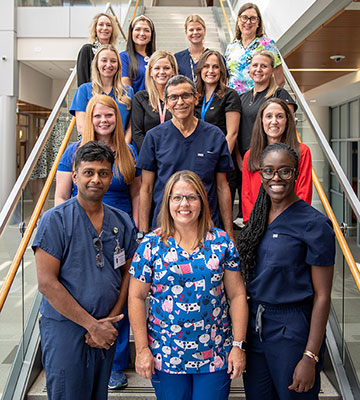
As Kentucky’s leading children’s hospital, we are committed to excellence in research, clinical care and education. With advanced diagnostic tools and treatment options, we provide personalized, family-centered care to meet every child’s unique needs. Our team includes providers who are nationally recognized for their expertise and research in pediatric gastroenterology.
Specially trained board-certified gastroenterologists work together with nurses, certified dietitians, nurse practitioners, a child psychologist and a support pharmacist. In addition to diagnosis and treatment, they offer advice on lifestyle changes to help manage your child’s symptoms.
Our team also works closely with specialists in pediatric surgery, pediatric allergy and aerodigestive care to provide your child with the high-quality care they need close to home.
Specialty clinics and programs
With years of expertise, we have established specialty clinics and programs that address many areas of GI and liver disease, including:
- Eosinophilic esophagitis
- Inflammatory bowel disease (IBD), including pediatric-to-adult transition clinic
- Metabolic dysfunction-associated steatotic liver disease or MASLD (formerly known as nonalcoholic fatty liver disease)
- Intestinal motility clinic
We provide advanced treatment and diagnostic services for children with inflammatory bowel disease. Kids with IBD have chronic inflammation of the GI tract. Their symptoms can include diarrhea, bloody stools, abdominal pain and weight loss.
The close physical and academic relationship between Golisano Children's at UK and the UK HealthCare adult IBD programs allows for a seamless, well-designed transition clinic where both the adult and pediatric team can see the patient and family in the same area and plan future care. We are also involved in ImproveCareNow, an international, multi-institution collaborative that focuses on improving the outcomes of patients with IBD.
We have a special clinic to help young people manage their IBD as they become adults. Our experts work collaboratively with adult GI specialists and other team members – including a psychologist, dietitian, social worker, pharmacist and nurse/transition coordinator – to provide young people with the support and education they need to manage their condition. Our multidisciplinary team can assess a patient’s disease and provide a tailored plan.
Our Pediatric Neurogastroenterology and Motility Disorders Program offers compassionate and leading-edge care to children of all ages with functional gastrointestinal disorders (FGID). These conditions are also known as disorders of gut-brain interaction (DGBI).
We address an array of complex issues relating to how the digestive system moves and senses food. Our main focus is to accurately diagnose and relieve your child's symptoms. We do this by using advanced diagnostic tools and effective treatment plans.
Neurogastroenterology focuses on the connection of the nerves between the brain and the gut. The nerves in the GI tract communicate with nerves from the brain, which aid in regulating its functions.
Gastrointestinal (GI) motility is the term used to describe how the GI tract moves food throughout your body using muscle contractions controlled by nerves.
Children can have issues with food passing too slowly through their bodies (resulting in constipation) or too fast (leading to diarrhea). The nerves in the GI tract not only help with moving food but also with how the GI tract senses food. Sometimes children have increased sensation (hypersensitivity). This can result in FGID such as functional abdominal pain and irritable bowel syndrome.
We work closely with our pediatric surgeons and perform combined procedures with our ear, nose and throat (ENT) and pulmonary specialists when needed.
It takes a dedicated team of providers to suspect this condition, make the diagnosis and then determine the best way to manage it.
Here at Kentucky Children’s Hospital, we have the team and technology help identify and manage children with eosinophilic esophagitis. Our multi-team approach allows us to manage diets, provide support to patients and their families, and use medical therapy when needed to treat this condition.
Conditions we treat
Our team is here to guide your child and family through every facet of care, from diagnosis through recovery. Conditions and symptoms we treat include:
- Abdominal pain
- Acute/chronic liver disease
- Allergic disorders of the gastrointestinal tract
- Celiac disease
- Chronic diarrhea
- Constipation
- Crohn’s disease
- Dysphagia/swallowing disorders
- Encopresis
- Eosinophilic esophagitis
- Esophageal stricture
- Functional gastrointestinal disease
- Gallbladder disease
- Gastrointestinal bleeding
- Gastroparesis
- Hepatitis (acute and chronic)
- Inflammatory bowel disease
- Intestinal polyps
- Malnutrition (including failure to thrive)
- MASLD (formerly fatty liver disease)
- Nutritional disorders
- Pancreatitis (acute and chronic)
- Peptic ulcer disease
- Poor weight gain
- Reflux/heartburn
- Short bowel syndrome
- Ulcerative colitis
- Vomiting
Tests offered
Anorectal manometry (also known as anal manometry) checks how well the muscles that control bowel movements are working.
In capsule endoscopy, the patient swallows a capsule with a tiny camera in it. This lets us take pictures of parts of the small intestine that can’t be seen with a standard endoscope.
During a colonoscopy, a long, flexible tube with a light and a camera is used to look at the lining of the large intestine (colon). The patient is asleep with anesthesia for this test.
During contrast studies of the gastrointestinal tract, the radiology team will use a contrast liquid to take better pictures of the intestines. This lets us see their shape, look for blockages, and check how fast the contrast moves through the intestine. Studies of the upper or lower intestine can be done.
Esophageal manometry checks if the muscles that help you swallow are working as they should. A small tube is passed through the nose into the esophagus. This helps us see your swallowing movements.
Endoscopic retrograde cholangiopancratography (ERCP) is used to find and treat problems of the gallbladder, bile ducts, liver and pancreas. The patient is asleep with anesthesia for this.
A fibroscan study is a special ultrasound that measures how stiff the liver is and how much fat is in it. It shows us if there is scarring in the liver and helps us plan the treatment.
Magnetic resonance enterography (MRE) is a special MRI that takes detailed pictures of the small intestine. It helps find problems that cannot be reached with endoscopy.
A pH probe impedance test measures how often you have reflux – acid or food coming from the stomach back into the esophagus. It is usually done over 24 hours at home or in the hospital. It helps us see how bad reflux is and if there is a risk of it going into the lungs.
An upper endoscopy looks at the lining of the esophagus, stomach and first part of the small intestine. It helps find conditions such as ulcers, growths, blockages or signs of allergies and celiac disease. It is done while the patient is asleep with anesthesia.
Treatments offered
Swollen veins in the esophagus can lead to liver disease. Placing a band around the swollen veins helps them clot and reduces the chance of bleeding.
In some cases, Botox® can be injected to relax the anal or pyloric sphincter muscles and reduce pain from bowel movements. This is done when the patient is under anesthesia.
If the esophagus is too narrow, it can be hard to swallow food. When this happens, stretching the esophagus may make it easier to swallow.
Polyps are abnormal growths in the intestine. They can be removed during endoscopy using a snare and an electrical current. They are then sent to a pathologist for review.
If the liver is inflamed or injured, we may take a tiny sample to review. This is often done by Interventional Radiology and is normally performed while the patient is under anesthesia.
What to expect at your visit

Your appointment will be at the Pediatric Specialty Clinic, located on the second floor of the Kentucky Clinic on the main UK HealthCare campus.
It is OK for your child to eat before their appointment. A scope will not be performed during the first office visit.