
Harnessing artificial intelligence to prevent cardiac events
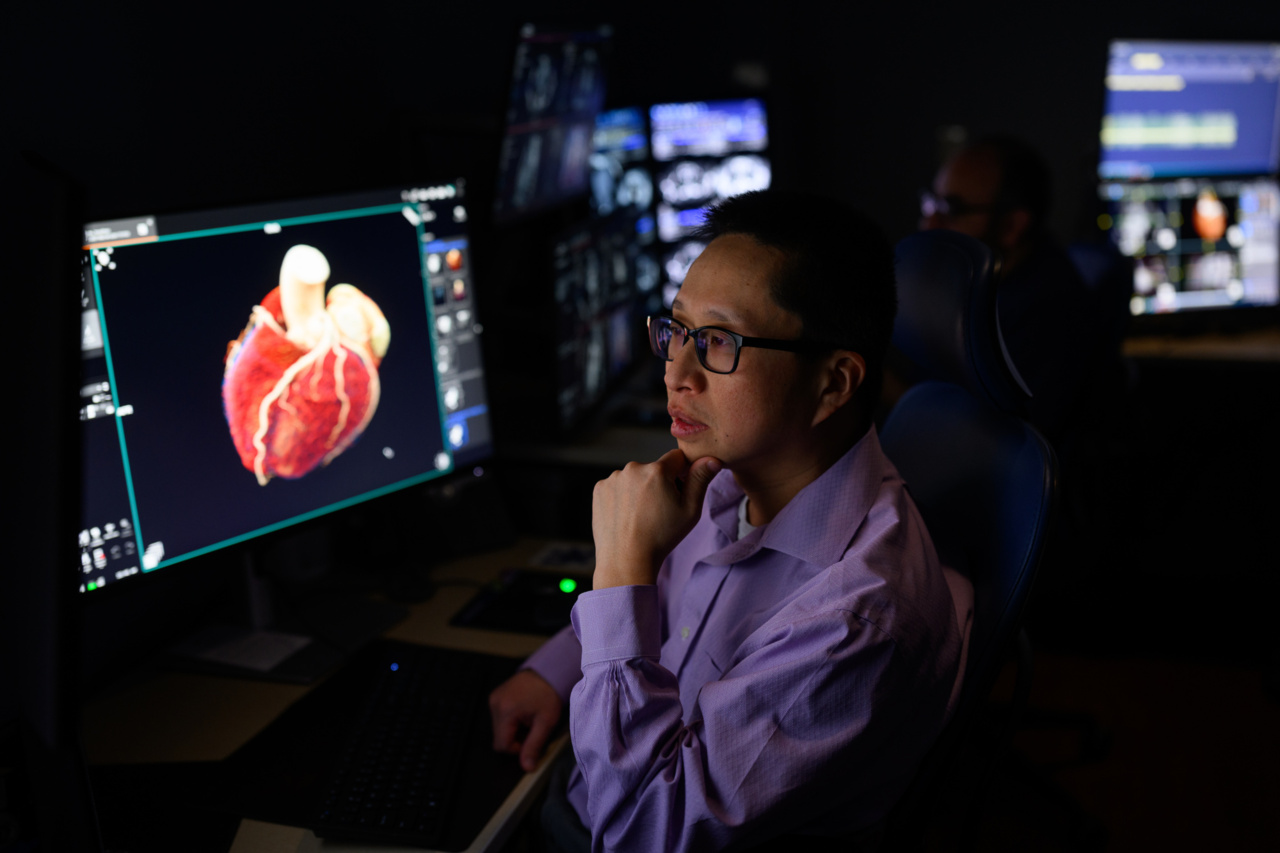
Artificial intelligence (AI) is already helping healthcare professionals more quickly and accurately with a host of medical problems. And as Dr. Steve Leung, director of advanced cardiac imaging at UK’s Gill Heart & Vascular Institute, continues his research to further develop AI’s use in imaging, he hopes to identify patients as risk of a heart attack or other cardiovascular problems long before a cardiac event occurs.
“AI can be very efficient when it comes to reading studies, but machine learning relies on large datasets, so we have been looking at nearly 100,000 imaging studies to develop and test the machine learning algorithm,” Dr. Leung says. “If computers can find the patterns and we can validate what the computer has learned, we can then move to the next step, using these algorithms clinically to be more efficient and more accurate in making a diagnosis.”
Through UK’s Executive Clinical Expert Leadership (EXCEL) research program, Dr. Leung is working closely with Brent Seales, PhD, chair of the College of Engineering’s Department of Computer Science, Cody Bumgardner, PhD, director of the Center for Applied AI, and Moneera Haque, MD, PhD, preventive cariologist and principal investigator on the project. They are developing a new model for better detection of coronary artery calcium using computed tomography (CT).
Ultimately, Dr. Leung would like to see all chest CT’s mined for cardiovascular insights. “One of the most common imaging tools today is a chest CT,” he says, “Patients have chest CT’s done frequently for lung problems, infections like pneumonia, cancer screenings, blood clots or post-trauma. If we can us AI to identify cardiovascular issues such as stenosis or an accumulation of plaque around the coronary arteries or inflammation, we may be able to prevent cardiac event altogether.”
With heart disease ranking as the number one killer in Kentucky – and the U.S. – using AI to help diagnose cardiovascular disease is more than a lofty goal, Dr. Leung says.
“AI is already helping us take care of patients more quickly, and that’s important because if we can create a report or get through paperwork in 10 minutes rather than 30, we can decrease patient wait times. But improving patient care by preventing heart attacks – by identifying a problem that you cannot see with the human eye and being able to do something about it before damage is permanent – will bring significant change.”