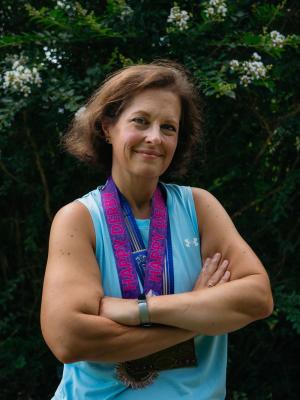


'Now I take up space with my personality.'
Key takeaways
• Jess Williams had weight-loss surgery at UK HealthCare in 2023 after years of emotional eating and serious health issues.
• She lost 186 pounds, reversed symptoms of intracranial hypertension (pressure on the brain often linked to excess weight), and now plays, travels and runs with her son.
• She credits the care team at UK HealthCare for supporting her before, during and after surgery.
Jess Williams knew something had to change.
She had always used food to cope. But in 2022, her migraines became so severe she could barely function. Her weight had crept to more than 400 pounds. And, raising a toddler alone and recovering from a divorce, she found herself overwhelmed and in pain.
“I’ve been an emotional eater my whole life,” said Jess, a newborn care specialist in Lexington who is now in her early 40s. “Food was how I dealt with life. But when the migraines started, I knew something had to change.”
The headaches were so intense she could barely function. “I couldn’t look at a computer screen without getting sick,” she said. “My neurologist looked at me and said, ‘You have to lose weight.’”
At the time, she was working full-time with kids and raising her toddler son alone. Yet, “I couldn’t carry my son,” she said. “I couldn’t get on the floor with kids at work. I was miserable in my body.”
Doctors diagnosed her with intracranial hypertension — pressure around the brain often caused by excess weight — and warned she could lose her eyesight if she didn’t take action. She made an appointment at UK HealthCare’s Weight Loss Surgery Clinic in August 2022.
“I wanted to see my kid grow up,” she said. “That was the turning point.”
She had gastric sleeve surgery in January 2023, a procedure that removes a large portion of the stomach to help reduce hunger and portion sizes.
Since then, she’s lost 186 pounds, and says she got her life back.
“Now I take up space with my personality, and I’m OK with that.”
Support without shame
From her first visit, Jess said she has felt seen and supported.
“I went in at 385 pounds, and they didn’t judge me,” she said. “They said, ‘All right, what do we do? Here we go.’”
She said the clinic’s team made her feel like a real person, not just a number on a chart. “They remembered details about my life. That meant something to me.”
She met regularly with the team before surgery and followed their key rule: Don’t gain weight between appointments. “I lost about 30 pounds before surgery,” she said.
She also gave up soda, a huge shift. “I was drinking eight to 10 Cokes a day,” she said. “Once I stopped, I dropped 20 pounds just from that.”
At the clinic, Jess learned a different approach to food.
“They’re not yelling at me for eating chocolate cake,” she said. “They say, ‘Have a slice. Just don’t eat the whole thing.’”
She now drinks protein coffee in the morning — 30 grams of protein in one cup. She sticks to smaller portions and avoids drinking liquids while eating, which can cause discomfort after surgery.
“The mental part is harder than the physical,” she said. “Especially if you’re an emotional eater.”
She started therapy to work on body image. “I still look in the mirror sometimes and see the 400-pound girl,” she said.
In February 2025, she had surgery at UK HealthCare to remove 6 pounds of extra skin from her abdomen. “I don’t have a belly button anymore,” she said with a laugh. “That’s my new party trick.”
She’s scheduled for another round of plastic surgery in January 2026.


Measuring progress beyond the scale
Mary Beth Keeton, UK HealthCare’s metabolic and bariatric nurse manager, said Jess embraced what they call “non-scale victories.”
“Crossing your legs for the first time. Buckling your seatbelt without an extender. Playing on the floor with your child,” Keeton said. “Those little things matter more than people realize.”
Keeton said the clinic encourages people to track those wins — especially during plateaus. “When the number on the scale doesn’t move, those victories keep people going.”
Jess agrees. “I cried the first time I went down a slide with my son,” she said. “I cried on the plane when I didn’t need a seatbelt extender.”
She’s also discovered a new relationship with clothes and style. “For so long, I wore whatever fit,” she said. “Now I can go into any store and find something I like.”
Keeton said the clinic stays involved long after surgery.
“We’re not just a place where you have a procedure and never hear from us again,” she said. “We’re a program. We’re with you for life.”
“That made all the difference,” Jess said. “I never felt alone in this.”
Before surgery, Jess briefly tried weight-loss medication but didn’t feel well. For her, surgery was the more sustainable choice.
“There’s nothing easy about it,” she said. “But I knew I needed something permanent.”
Jess now runs her own business and spends more time with her son.
“I want to go on adventures with him. I want to see him grow up,” she said.
She shares her story so others know it’s possible.
“I didn’t think I was worthy of this,” she said. “If I can help convince someone else to take that first step — even if you’re 70 — it’s worth it.”