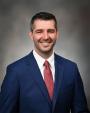


A heart surgeon who's been there
Key takeaways
• At age 8, Dr. Kyle Riggs was on the sidelines, healing from heart surgery.
• He still carries the scar, and it helps him connect with families facing the same challenges.
• As a pediatric heart surgeon at Golisano Children's at UK, he brings both skill and the perspective of someone who has been there to every surgery.
One spring day in Missouri, Kyle Riggs sat on the bench during his Little League game. His teammates ran across the diamond, but his uniform stayed clean, his glove tucked under his arm. A long scar marked his chest.
“I remember kind of being sidelined in the middle of baseball season, just sitting out in my Children’s Mercy Hospital shirt on the sidelines cheering,” he said. “And then a few weeks later, I got right back into it.”
Not yet 10, he had already survived two heart operations.
Today, Dr. Riggs stands on the other side of the operating table as a pediatric heart surgeon at Golisano Children's at UK. Parents who meet him see more than a doctor. They see someone who knows what it’s like to be the child on the bed.
“I love seeing kids before surgery, getting to know their personalities, and then seeing them recover,” said Dr. Riggs, who is part of the Joint Pediatric and Congenital Heart Program at UK Golisano Children's. The program is a collaboration with Cincinnati Children’s that brings together cardiac experts from both hospitals to create one of the top pediatric heart programs in the country.
“One of the best things is walking them through it and giving them hope,” Dr. Riggs said of his young patients. “I’ve been there.”
The boy with the scar
“I was born with Tetralogy of Fallot, a fairly lethal lesion if untreated in the first few years of life,” Dr. Riggs said. “I had my first surgery when I was 15 months old, which by today’s standards is actually pretty old, but it was fine.”
At age 8, he had his second operation. A year later, while pitching in a baseball game, he felt a searing pain.
“When I was 9, I had a sternal wire fracture,” he said, meaning the wire used to close his sternum after heart surgery had broken. “I was on the mound pitching, and just the torque on my chest somehow fractured that wire. I thought I was having a heart attack or dying, but it was just a little wire.”
Despite those scares, he grew up playing sports, encouraged by parents who never let him be defined by illness. His mother’s steady optimism shapes his memories. “We had a good surgeon and a good cardiology team, just a very positive experience being in the hospital that I hope to recreate for the families that come through for me,” he said.
Even now, when he sits with anxious parents, he draws on those days. He knows what a calm word and a steady hand can mean.
By high school, he had found a clear calling. At 16, a career aptitude test pointed him toward health care. Soon after, he sat in his cardiologist’s living room.
“I had a meeting with my cardiologist one day at his house. We were watching ‘Jeopardy’ and drinking Coke,” he said. “I asked him what the path was to becoming a pediatric cardiologist. He laid it out, 15 years more of training, and I wasn’t deterred.”
The aspiring doctor realized surgery suited him best. “I’ve always been very hands-on and loved Legos, and building was kind of my thing,” he said. “So, when I was 16, I decided I want to be a pediatric heart surgeon.”
The making of a surgeon
Training took him from Missouri to New York to Cincinnati. He completed a six-year cardiothoracic residency, followed by research and fellowship training. He gave up most of his 20s to long days and sleepless nights, but he never wavered.
“You just have to have that determination to learn something every day and remain hopeful and steadfast in what you’re doing,” he said. “One day it will all be worth it.”
Mentors left a lasting mark. “When I was in college, I went back and shadowed Dr. Gary Lofland, who did my second surgery,” Dr. Riggs said. “There was still a nurse there who had been in my case when I was a baby.”
Later came an even more personal connection. “When I was in med school, I got to meet my first surgeon, Dr. Keith Ashcraft. He was retired and painting. I asked him if he would do a watercolor for me since he was my surgeon, and I have it,” Dr. Riggs said. “He wrote me a letter on the back wishing me luck. It’s had a lasting impact.”
In summer 2025, his path brought him to UK Golisano Children's, where he now operates on patients anywhere from a few days old into adulthood (there’s no upper age limit). He chose Kentucky for the chance to build a congenital heart program where families feel known. “I love that it’s a smaller program, so I do have an opportunity to spend this extra time with families and really give them very dedicated care,” he said.
Carrying the scar
Dr. Riggs said parents often find comfort when he shares his story, but he doesn’t promise an easy path.
“I don’t want to confuse them and make them think that everyone has such a great outcome,” he said. “But I do want to give them that hope, especially if they’re extremely worried.”
He also notices details other surgeons might not. “I get out of the shower and see the scar on my chest,” he said. Because of that daily reminder, he works carefully to minimize scars for his patients, knowing how much it can shape confidence, especially during adolescence.


Living with a heart condition himself, he also thinks in decades, not months. Survival has improved, but he wants to know how people are doing years later. “I want to start putting together ways to follow our patients long term,” he said. “What are realistic expectations that we can give the family?”
Dr. Riggs is also interested in ways to limit repeat surgeries. One is the Ross procedure, where a diseased aortic valve is replaced with the person’s own pulmonary valve, and a donor valve takes its place. Because the new aortic valve is living tissue, it grows with a child and can last far longer than an artificial one. “Personally, I would not want to have another heart surgery, and I want to give people as few operations as possible to get the best result,” he said.
More than survival
Away from the hospital, Dr. Riggs and his wife, Marya, are raising two toddlers, Mila and Coast. He spends much of his free time in the neighborhood, walking with his children to see the horses nearby. “When I’m at home, it’s just 100% dad and husband mode,” he said. The rhythm of family life grounds him. It gives him perspective, energy and the strength to face the high-stakes work of surgery.
“Every time I think about what I’m doing, I think back to my story, my personal experience, trying to be empathetic and compassionate with families, while giving them my best medical advice.”
For him, success is not only sending a child home from the hospital. “In my mind, a successful surgery would be a patient outliving me,” he said. “Not just getting home, but not being limited by their cardiac disease to the best of our ability.”
Riggs carries his childhood into every case. The scar that once kept him on the sidelines now guides the care he gives to Kentucky families.