
The power of foresight
Advancing biomarker research to change the Parkinson’s journey
For the families and caregivers of the estimated six million people worldwide with Parkinson’s disease, the tremors and movement difficulties typical of the condition are only part of the challenge.
The devastating reality is that 50-80% of people with Parkinson’s will eventually develop cognitive impairment, fundamentally changing their lives and the lives of those who care for them.
Dr. Tritia Yamasaki, associate professor in the University of Kentucky Department of Neurology, is working to change that trajectory with resources provided by UK’s Center for Biomedical Research Excellence (COBRE) in Central Nervous System Metabolism (CNS-Met) Core.
As a research project leader under the CNS-Met COBRE led by Dr. Patrick Sullivan, Dr. Yamasaki is supported by a grant from the National Institute of General Medical Sciences, part of the National Institutes of Health. Her project focuses on searching for biomarkers that could predict which patients will develop dementia — potentially years before dementia symptoms appear.
“Earlier work in our lab identified specific pathways that are dysregulated in Parkinson’s disease,” Dr. Yamasaki said. “Now, we’re examining metabolites and lipids present in body fluids and comparing them to changes we see in cognition over time.
"If we can find a way to predict who is going to go on to develop cognitive impairment, it would provide new insights into the disease, help pinpoint new targets for intervention and assist in tailoring treatment by guiding our choice of therapeutics.”
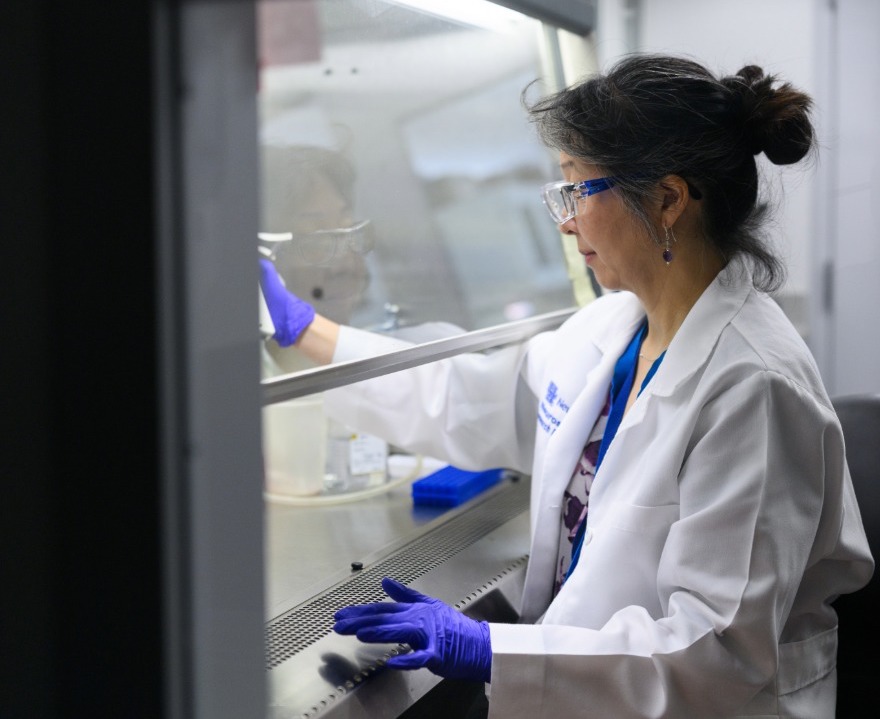
Using liquid chromatography-mass spectrometry methods available in the CNS-Met Core, her team analyzes blood and other biofluid metabolomic profiles from patients diagnosed by movement disorder specialists.
The approach is notably less invasive than traditional methods that required surgical biopsies or lumbar puncture to obtain cerebrospinal fluid.
Participating patients undergo comprehensive neurocognitive assessments and motor function evaluations while on and off their medications. They also provide survey information about dietary history and non-motor symptoms associated with their condition. Biosamples are obtained at baseline and two-year timepoints.
While Dr. Yamasaki’s current work on this project focuses primarily on metabolomic changes in Parkinson’s disease and related movement disorders, her earlier research laid important groundwork for understanding protein misfolding across neurodegenerative diseases.
Because Parkinson’s disease, Alzheimer’s disease and other neurodegenerative disorders share common features, including disruptions of CNS metabolism and mitochondrial dysfunction, there are promising implications for her work beyond Parkinson’s.
“Participating in a research trial is just one way that patients can be empowered,” Dr. Yamasaki said. “We offer other resources to patients, including free genetic testing through the Parkinson’s Foundation and let them know about community support groups such as the Bluegrass Parkinson’s Association.
"Many of our patients say they are participating in research because they understand that they are contributing to knowledge that could transform treatment in the future. And for us, the opportunity to give our patients and their families the power of foresight in managing this complex disease, rather than simply reacting to it, drives everything we do.”