
Working together for a healthier region
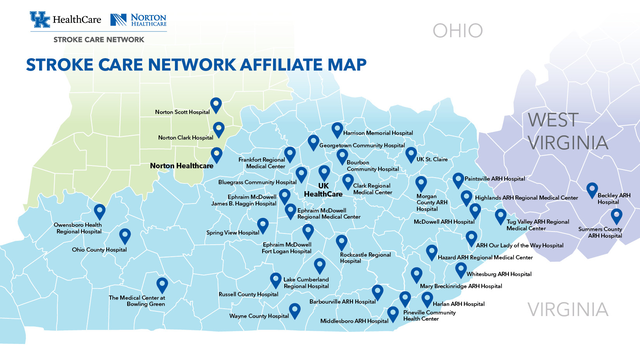
The Stroke Care Network spans 41 affiliate hospitals across three states to ensure that
The Stroke Care Network – a collaboration between UK HealthCare and Norton Healthcare – is proof that we are stronger together.
As the first community-based stroke program in the region, the Stroke Care Network is designed to provide the highest quality clinical care and educational programs to physicians, hospital staff and community members. Founded in 2008, the network now has 41 affiliate hospitals in Kentucky, western West Virginia and southern Indiana.
“The Stroke Care Network is here to support hospitals across the Commonwealth (and beyond) in optimizing stroke care within their communities. Our goal is to make sure that everyone receives top-notch services, no matter where they live,” said Dr. Larry Goldstein, interim director of the Stroke Care Network. “Each hospital has made a strong commitment to providing current and clinically effective stroke care for the community.”
The UK Comprehensive Stroke Center and Norton Healthcare support these efforts by providing clinical guidance and oversight, making sure that stroke patients receive the right treatment at the right time.
These three pillars guide the network’s goals: quality improvement, clinical and provider education, and community outreach and prevention.
Quality improvement
In 2024, Kelley Elkins, BSN, RN, accepted the role of managing director of the Stroke Care Network. She had previously held roles as education and quality coordinator, and quality and research associate in the UK HealthCare Comprehensive Stroke Center, and her focus on quality improvement takes a starring role within the Stroke Care Network.
Efforts to improve quality enable the network to refine protocols, streamline processes and enhance interdisciplinary collaboration. These improvements ultimately lead to better patient outcomes and satisfaction.
In 2024, the Stroke Care Network established two new goals for the affiliate hospitals:
1. Ensure Door-to-needle time is 60 minutes or less. Door-to-needle measures the time from a patient’s arrival in the Emergency Department to the administration of IV Thrombolytic.
2. Ensure Door In Door Out time is 120 minutes or less. Door In Door Out (DIDO) measures the time from a patient’s arrival in the Emergency Department to the transfer to another hospital.
“Building and maintaining stroke programs that adhere to evidence based standards of care and prioritize continuous quality improvement is crucial. Our goal in collaborating with the affiliates is to assist them in effectively managing appropriate patients close to home while ensuring the swift transfer of high-acuity cases when necessary,” Elkins said. To further that effort, the team tracks and analyzes data allowing the team to monitor key performance metrics, monitor trends over time, and make informed decisions that drive enhancement of network stroke programs’ effectiveness and efficiency.
Clinical and provider education
The Stroke Care Network strives to provide a strong base in clinical education to all healthcare providers who may impact stroke care: physicians, advanced practice providers, pharmacists, nurses, EMS, speechlanguage pathologists, and physical, occupational and respiratory therapists. Some of the major educational opportunities offered include:
• The Comprehensive Approach to Stroke (CATS) program, an accredited educational seminar series for healthcare professionals. Sessions are virtual. Topics covered include inpatient care, emergency department protocol, case study review and more.
• Seven enduring CME web-based learning modules to provide an alternative to in-person training. Each module is fully accredited and can be done online at a time convenient for any participant.
• Apex Hemispheres 3.0 Stroke Competency Series, an accredited online educational course comprised of nine modules focused on stroke related topics.
• Education on the Go, a new stroke educational pilot program. The network provides stroke educational posters targeted for EMS, RNs, and physicians. The affiliate hospital then prints the posters and places them in a visible area. Upon reviewing the educational material, participants can simply scan a QR code and answer a few questions. Once the questions have been successfully answered, an email with further instructions will be sent to complete accreditation.
Community outreach and prevention
Another core value of the Stroke Care Network is educating people in communities across the region about the things they can do each day to live healthier lives and reduce their stroke risk.
The Stroke Community Outreach, Prevention and Education (SCOPE) program plays a pivotal role in raising awareness and promoting proactive health practices.
The network and affiliates provide this education for children and adults through interactive health screenings, informational sessions and targeted outreach efforts.
To date, the SCOPE Program has educated over 58,000 individuals through more than 1,300 events.
Looking forward
Dr. Goldstein’s goal is constant improvement and expansion of the network. “As we look ahead, we remain committed to pushing the boundaries of stroke care excellence, guided by our mission to provide compassionate, state-of-the-art and accessible care to all those affected by stroke. Together, we will continue to build a future in which every stroke patient receives the highest level of care and support.”