
Orientation Guide for Observation & Learning Experiences
Welcome
Welcome to University of Kentucky (UK) HealthCare! We are pleased you made the decision to participate in a learning experience with us. As an academic medical center, we are committed to the three pillars of academic health care: (1) clinical care, (2) research and (3) education. Whether you are observing, completing a practicum, or volunteering with research, you play an integral role in fulfilling UK HealthCare's mission.
We commit to providing you with the necessary tools and support to help ensure a positive experience. This written guide outlines general information and basic procedures and is designed to supplement the departmental orientation session. Please review and retain this document for your reference. Ask our office or your supervisor if you have questions regarding the material.
UK HealthCare Mission, Vision & Values
Mission
UK HealthCare is committed to the pillars of academic health care—research, education and clinical care. Dedicated to the health of the people of Kentucky, we will provide the most advanced patient care and serve as an information resource. We will strengthen local health care and improve the delivery system by partnering with community hospitals and physicians. We will support the organization's education and research needs by offering cutting edge services on par with the nation's best providers.
Vision
The vision of UK HealthCare is to achieve national recognition as a Top 20 public academic health center, providing optimal multidisciplinary health care and developing advanced medical therapeutics for the people of Kentucky and surrounding regions.
Values
-
Discovery
- We are committed to continuous learning, genuine curiosity and deeper understanding of the many people and communities we serve across the Commonwealth.
-
Innovation
- We embrace continual learning and improvement to drive positive change.
-
Respect
- We value our patients and families, our community, our co-workers, ourselves and the resources entrusted to us.
-
Ethics
- As an institution dedicated to healing, discovery and education, we uphold the highest ethical standards to ensure patient trust, integrity in research and educational excellence.
-
Compassion
- We express empathy for the needs, thoughts and feelings of those we serve and with whom we work.
-
Teamwork
- We cultivate meaningful relationships to create positive outcomes.
Identification & Access
Identification
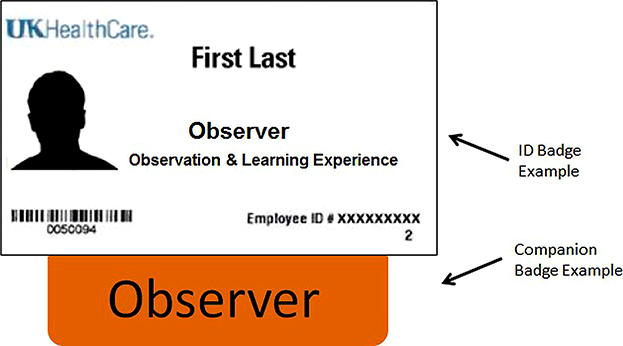
The Office of Observation and Learning Experience (OLE) will issue a companion badge to be worn in tandem with an identification (ID) badge. The companion badge clearly identifies your role within UK HealthCare and indicates compliance with enterprise-level requirements. OLE will determine if an existing ID badge may be utilized or if an ID badge shall be ordered and retrieved from the ID Security Office. The initial cost of badges is borne by OLE; however, fees for lost, stolen, and temporary badges are borne by the learner. Retrieve your companion badge from OLE prior to beginning your experience. If applicable, instructions to acquire an ID badge from the ID Security Office, located at a different site, will be provided.
A government-issued photo ID is required to receive badges. Badges shall be worn at all times and be in a visible location above the waist. Companion badges shall be returned to OLE and identification badges shall be returned to the ID Security Office (if applicable) immediately following the completion of your experience.
Facility Access
Observers are not provided access to enter areas on their own and must be escorted at all times throughout their observation experience. Students and research learners may be provided access by their sponsoring department to areas deemed appropriate for the completion of their practicum or volunteer experience.
Although you will be wearing identification badges, you shall be introduced by the UK HealthCare employee when entering a patient's room. The patient or family member shall give verbal consent before you may begin participating in observation or learning activities. UK HealthCare employees shall reserve the right to ask you to leave if at any time it is perceived your presence interferes with patient care or employee activities.
Software & Hardware Access
Observers are generally not provided computer privileges since the nature of the experience is for observation only. Students and research learners may be provided access to software, hardware, and PHI deemed appropriate for the completion of their experience and within compliance of pertinent policies. Access will be determined by each department.
Parking
Visit the Transportation Services office prior to your first day to purchase a permit and determine your parking options. They are located on the ground floor of Parking Structure #6 (721 Elizabeth Street, Lexington, KY) and are open Monday–Friday, 7:30 a.m. to 7:30 p.m. Transportation Services staff can also answer questions regarding permit costs, parking, and transportation options. Parking in the hospital patient/visitor garage and the KY Clinic garage is strictly prohibited during your learning experience. Ask your sponsor or preceptor for parking information if your site is off campus.
Health
Health requirements are designed for the health and safety of our patients, staff, and learners. Please remember a healthcare facility is a potentially hazardous place. There are certain health risks that come with any health care facility and specific precautions must be taken to minimize those risks.
Immunizations
A flu vaccination is required each flu season (October 1 – March 31). The state of Kentucky also requires evidence of annual tuberculosis testing. Cost of immunizations, if applicable, is borne by the learner.
Immunization requirements may be exempt to persons who have a medical contraindication to the vaccine or a religious objection as defined by the Americans with Disabilities Act. The Office of Observation and Learning Experience can provide additional instruction if requested.
Infection Prevention & Control
Hospital employees and students follow standard precautions when caring for patients. Standard precautions apply to blood, body fluids, secretions, excretions (except sweat), non-intact skin, and mucous membranes. Standard Precautions are used with every patient every time. If the patient is on additional infection control precautions, such as isolation, a sign will be posted on the patient's door.
- Always wash your hands before and after entering a patient's room.
- Always avoid contact with any body fluids, unless engaging in activity required for a student practicum.
- Always use appropriate personal protective equipment such as gloves, masks, eye protection, and/or gowns.
- Never enter a room occupied by a patient with a precaution/isolation sign on the door, unless engaging in activity required for a student practicum.
Basic Hand Hygiene Procedure
- Use an approved soap or alcohol-based hand sanitizer.
- When using soap and water, wash for at least 15–20 seconds.
- When using alcohol-based hand sanitizer, rub your hands together until your hands are dry.
- Wearing gloves does not replace the need for hand hygiene.
Occupational Exposure
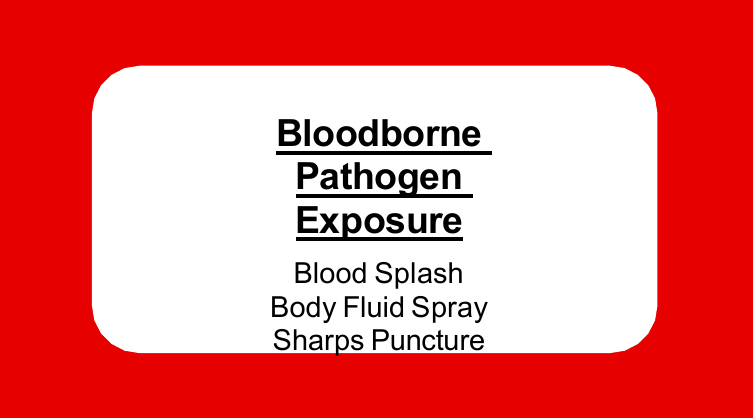
Notify your preceptor/sponsor immediately in instances of exposure to body fluids or infectious disease. The UKHC employee shall complete the applicable Exposure Packet and follow procedure as outlined by the office of Infection Prevention and Control (IPAC). Also, immediately notify the appropriate contact with your home institution so additional procedures can be followed. For students, it is highly advised to understand exposure protocols before beginning a practicum.
Exposure packet resources differ based on your home institution. See information below.
University of Kentucky Students
The Exposure Packet is found in myUK under the "Occupational Exposures" tab.
Questions?
Mon–Fri, 7:30 a.m.–4:30 p.m.: 859-218-3253
Mon–Fri, 4:30 p.m.–7:30 a.m. and Weekends/Holidays: 859-257-5522

Non-University of Kentucky Students
The Exposure Packet is electronic. Your sponsor/preceptor will provide this for you.
Questions?
Mon–Fri, 7:30 a.m.–4:30 p.m.: 859-323-6337
Mon–Fri, 4:30 p.m.–7:30 a.m. and Weekends/Holidays: Call UK MD paging and request to speak to the IPAC Infection Preventionist on call.
Safety
UK HealthCare is committed to creating, promoting, and maintaining a safe, healthy environment. Our safety programs conform to applicable local, state, and federal safety and health standards, fire codes, and environmental regulations. Program highlights are below; more detailed information can be provided by your sponsor or preceptor.
Emergency Codes
Specific codes are used to alert staff about hazards or potential hazards in the area, or to call designated staff to action. Designated staff members have assigned roles in response to these codes.
| Code | Meaning |
|---|---|
| Code Red | Fire |
| Code Silver | Active Shooter |
| Code Pink | Infant/Child Abduction |
| Shelter in Place | Chemical/Biological Release |
| Code Yellow Stand By or (Complete) | Mass Casualty |
| Tornado Warning | Announcement |
| Code Blue | Cardiopulmonary Arrest |
| Assistance Please | Combative Patient, Visitor, or Staff |
| Code Violet | Activates the Behavioral Emergency Response Team (BERT) for patients |
Fire Safety
Prevention: UK HealthCare is constructed with many life safety features to protect building occupants from fire, such as sprinklers, fire/smoke doors, and heat/smoke dampers. Below are tips for fire safety and prevention:
- Note locations of fire alarms, pull stations, extinguishers, evacuation routes, and emergency exits within or adjacent to the areas you are observing or completing a learning experience. You are not required to use a fire extinguisher.
- Be aware of fire hazards such as oxygen and other medical gases; flammable substances; electrical equipment; combustibles such as trash, latex gloves, and linens; and grease from cooking.
- Keep combustibles and flammables away from heat.
- Keep equipment that can create sparks out of areas in which oxygen is used.
- Dispose of trash and medical gas cylinders appropriately.
- Inspect your area for hazards and report concerns to your supervisor.
Notification: If fire, smoke, or excessive heat is detected within the medical center, the fire notification system is activated. You will hear chimes over the paging system, followed by Code Red.
During a Code Red:
- Listen to determine the location.
- Close all doors to corridors.
- Remove all objects in corridors.
- Listen for further instructions.
The Fire Department responds to all fire alarms at UK HealthCare. In most cases, you will be able to remain in the project site throughout the response. An alarm is silenced only after the Commanding Officer determines that the area is safe.
If you discover a fire — R.A.C.E.
- Rescue anyone in immediate danger.
- Activate the fire alarm; call 911.
- Contain the fire by closing all doors.
- Extinguish the fire or evacuate to safety.
To use a fire extinguisher — P.A.S.S.*
*Use of fire extinguisher is optional.
- Pull pin.
- Aim at base of fire.
- Squeeze handle.
- Sweep from side to side.
If you discover a fire — R.A.C.E.
- Rescue anyone in immediate danger.
- Activate the fire alarm; call 911.
- Contain the fire by closing all doors.
- Extinguish the fire or evacuate to safety.
To use a fire extinguisher — P.A.S.S.*
*Use of fire extinguisher is optional.
- Pull pin.
- Aim at base of fire.
- Squeeze handle.
- Sweep from side to side.
Interim Life Safety Measures (ILSM)
Whenever a construction or renovation project compromises the life (fire) safety systems or poses a significant increase in safety hazards, temporary systems or interim life safety measures will be implemented to help ensure the safety of occupants. Signage will be posted whenever an area is operating under interim life safety measures. If you are assigned to or will pass through an area undergoing construction or renovation, ask your sponsor/preceptor about ILSM specific to your area.
Hazardous Materials
Your preceptor will provide you with information about the hazardous materials with which you may come in contact before your learning experience. Safety procedures, including the use of safety equipment and reference materials, must be adhered to at all times. Additional safety training may be required of individuals volunteering in a laboratory environment and for students. Observers should not come into contact with hazardous materials. Consult your supervisor if you have questions about a product and its hazards.
Reporting Safety Issues
UK HealthCare requires employees to report all unusual occurrences involving patients, visitors, volunteers, students, observers, and employees by completing an online Safety Incident (SI). Reportable occurrences include but are not limited to:
- Falls
- Exposures
- Sharps injuries
- Lacerations
- Contusions
- Back injuries
- Burns
- Near misses
- Device/equipment malfunctions
- Any variation in standard practice that increases risk of or results in injury
Workplace Violence Reporting
All incidents of workplace violence must be reported by calling the appropriate number below:
- Verbal abuse, threats of violence, or other threatening behavior: 859-323-6156 (UKPD)
- Someone is brandishing a weapon: 911
- Combative individual, active shooter, and other emergency situations for overhead paging such as "assistance please": 859-323-5200, Option #2 (Chandler) or 5000 (Good Samaritan)
- If your site is off campus: ask your supervisor for contact numbers.
Patient Experience
The patient's experience is directly linked to quality, safe care. Every person at UK HealthCare impacts the patient experience. Patient Experience is "every patient, every encounter and every time."
Information desks are a valuable resource for our patients & families, and for us! 24/7 Information Desk Helpline: 323-5816

Consistent Best Practice: Five and Dime
This is a communication technique to use for every patient, coworker, clinician, or anyone else you pass in the hallway or public area.
Five & Dime
When you approach anyone — patients, families, visitors, employees — smile and make eye contact at 10 feet.
When you are 5 feet away — you greet them.
Communication Best Practice: AIDET
- Acknowledge
- Make eye contact, smile, and acknowledge family or friends in the room.
- Introduce
- Introduce yourself with your name, department, and role.
- Duration
- Manage and set reasonable expectations around the length of time the interaction or process will take.
- Explanation
- Explain step-by-step what to expect next and answer any questions for the patient or family members.
- Thank you
- Thank the patient and/or family. Express gratitude to them for choosing UK HealthCare or for their patience, cooperation, and partnership.
On Stage Behavior
Every person who holds an OLE badge is viewed as a member of the UK HealthCare community and actions in public and patient care areas are "On Stage." Our actions, appearance, and expressions should always promote professionalism and reflect concern for our patients, families, and each other.
| On-Stage Behavior (expected in patient and public areas) | Off-Stage Behavior (not permitted in patient and public areas) |
|---|---|
| Smile & make eye contact | Personal cell phone use |
| Clean & professional appearance | Foul language |
| Keep environment uncluttered | Personal internet use |
| Maintain low noise levels | Public expression of anger or frustration |
| Courteous & prompt responses to questions and needs | Talking about social life |
Language Access Compliance
Through Title VI of the Civil Rights Act, UK HealthCare is required to provide language services with qualified medical interpreters, sign-language interpreters, and translators who provide written translations to maintain accurate communication with all our patients. These services are offered across the enterprise at no charge and are available 24/7 when a patient identifies their preferred language. If you encounter a situation where language services are needed, please work with your sponsor/preceptor.
Abuse and Neglect
Each UK HealthCare employee or contractor has a professional and legal responsibility to report all suspected cases of abuse, neglect, exploitation, or abandonment for both minors and adults. If you believe someone you encounter is a victim of abuse or neglect, immediately notify a UK HealthCare employee. If you see something, say something.
- Neglect
- Failure to provide for a person's basic needs who are under the care of another person (e.g., child, elder, persons with a disability). Examples include food, clothing, hygiene, education, supervision, and medical care.
- Emotional Abuse
- An action that lowers self-esteem in an effort to dehumanize another person. Examples include belittling, shaming, or humiliation; name calling and negative comparisons to others; yelling, threatening, or bullying; and exposure to violence.
- Physical Abuse
- Non-accidental physical injury or infliction of physical pain to an adult or child. Examples may include hitting, punching, slapping, kicking, biting, pushing, aggressive pulling, or burning, as well as not allowing the individual to take prescription medication.
Corporate Compliance
All UK HealthCare team members are required to report any activity believed, in good faith, to be illegal, unethical, abusive, or in violation of the intent of UK HealthCare's compliance program within 24 hours of discovery of the activity.
- Talk to your sponsor/preceptor.
- Call the office of Corporate Compliance at 859-323-8002.
- Report online or via the UK Comply-Line (anonymous):
Student Practicums & Research Learner Activities
Individuals participating in clinical and administrative practicums for academic credit or degree requirements (classified as "students") and individuals volunteering with research (classified as "research learners") are permitted to engage in activities beyond observing, but only as they relate to the approved learning experience. You may be asked to participate in trainings and to showcase fundamental skills which reflect competence in your field of study or research activities.
Tobacco
UK HealthCare is committed to creating and maintaining a culture of compliance with the Tobacco Free Initiative. The University of Kentucky, including UK HealthCare, does not permit tobacco use in or around any of its facilities as of November 20, 2008.
Personal Cell Phone Usage
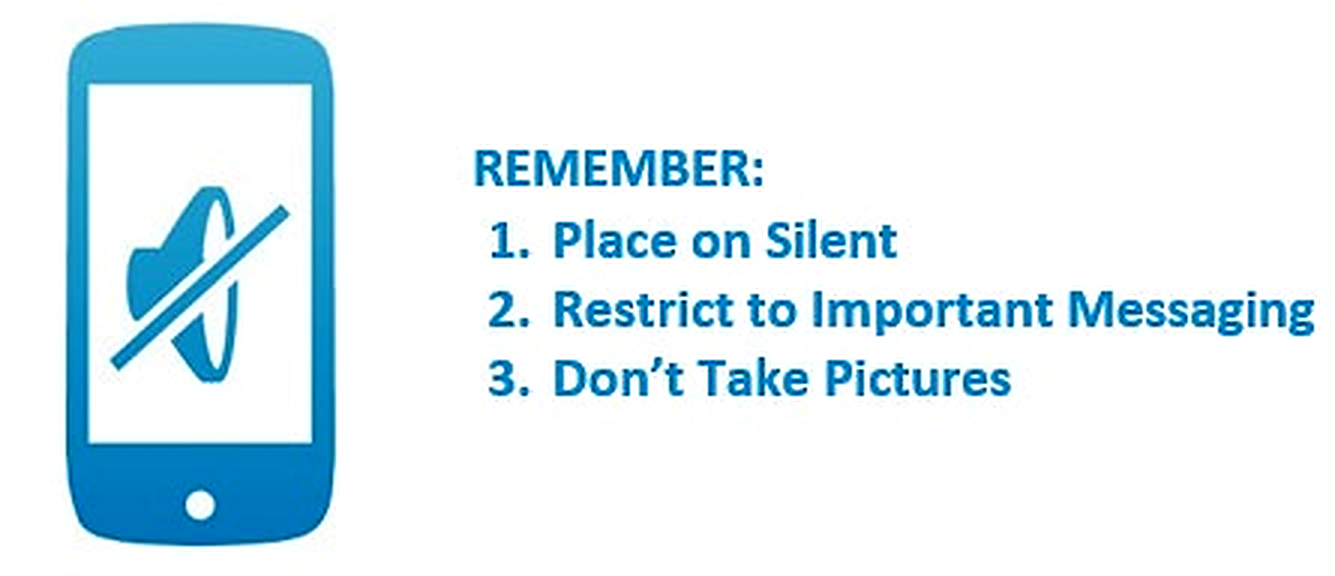
Cell phone usage is restricted to important calls and texts, which should be handled outside of patient care areas. Remember to place your phone on silent to limit distraction from patient care and other work-related activities. To protect privacy, taking pictures in patient care areas is strictly prohibited.
Remember:
(1) Place on silent.
(2) Restrict to important messaging.
(3) Don't take pictures.
Dress Code
UK HealthCare requires individuals to dress in a manner that presents a professional image to our patients, visitors, industry representatives, and to each other. Each learner shall maintain high standards of personal appearance and satisfactory hygiene. Business casual is usually acceptable and does not include jeans, shorts, sweats, short/tight skirts, sandals, or other inappropriate articles of attire. Scrubs and lab coats are unacceptable unless participating in an experience within an operating room or if required by the sponsoring department. Scrubs provided by the sponsoring department shall be returned immediately after use or penalties may be incurred. Appropriate identification shall also be worn at all times.
Regulations
Individuals engaging in learning experiences shall be subject to UK HealthCare policies and procedures, and to applicable federal, state, and local laws that may apply to their activities. Individuals who are subject to US visa requirements or restrictions may only participate in observations and learning experiences during the approved dates listed on their valid official visa documents.
Tips for a Successful Experience
- Wear comfortable shoes.
- Be prepared to stand and walk for extended periods of time.
- Know when your experience is, where your experience is, and who to ask for upon arrival.
- Arrive at your designated time, not after.
- Allow time for parking, shuttles, and/or walking to your destination.
Pertinent Contacts
| Department / Resource | Contact Information |
|---|---|
| Infection Prevention & Control | 859-323-6337 |
| UK HealthCare Corporate Compliance | 859-323-8002 Anonymous Comply-Line: 877-898-6072 |
| UK HealthCare Home Page | ukhealthcare.uky.edu |
| UK HealthCare Safety Office | 859-323-5734 |
| UK HealthCare Switchboard | 859-323-5000 |
| UK ID Badge Offices | UK HealthCare: 859-323-2356 Student Center: 859-257-1378 |
| UKHC Information Desk Helpline | 859-323-5816 |
| UK Police Department | uky.edu/Police/index.html Emergencies: 911 UK Police: 859-257-8573 or #UKPD from mobile phone UK HealthCare Security: 859-323-6152 or 859-323-6946 Safety Escorts: 257-SAFE (7233) LiveSafe App: uky.edu/EM/LiveSafe.html |
| UK Transportation Services | 859-257-5757 or 800-441-0555 721 Elizabeth Street, Lexington, KY 40506 uky.edu/transportation/ |
| Observation and Learning Experience (OLE) | 859-218-5792 or 859-218-5793 ukhealthcare.uky.edu — Observation and Learning Experience |
| Advanced Practice Provider (APP) Office | 859-218-6164 |
Updated 2024